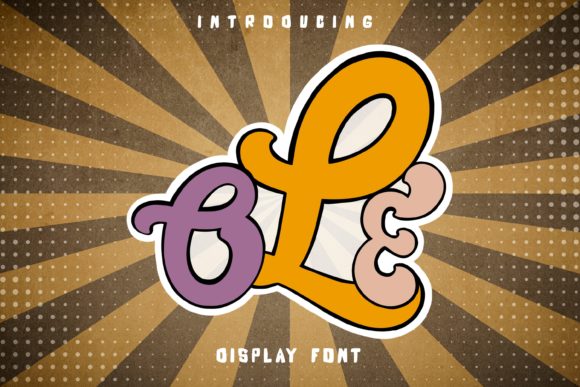
Ole Retro Handwritten Font for Crafters & Sellers
As someone who designs printable wall art, cuts vinyl stickers for local boutiques, and hand-presses greeting cards for Etsy buyers, I know how much a single font can shape the feel—and sales—of a product. That’s why Ole has become my go-to retro handwritten font for projects where warmth, authenticity, and subtle vintage charm matter most.
Ole isn’t just “cute” or “playful”—it carries the gentle imperfection of real pen-on-paper: slight variations in stroke weight, soft tapered terminals, and an easy, unhurried rhythm. It’s relaxed but never sloppy, nostalgic but not dated. Think 1970s stationery meets modern craft sensibility—ideal for small-batch makers who want their labels, tags, and packaging to whisper “handmade with care” before the customer even reads a word.
Where Ole Shines in Real Craft Projects
I use Ole across physical and digital product lines—not as filler, but as intentional design language. Here’s where it delivers consistent results:
- Stickers & Vinyl Decals: Ole cuts cleanly on Cricut and Silhouette machines at sizes as small as 0.5" tall (with clean spacing and no overlapping swashes). Its open letterforms prevent inner cuts from collapsing on tiny adhesive labels—perfect for candle jars, soap bars, or mini herb sachets.
- Tote Bags & T-Shirts: Screen-printed or heat-pressed, Ole holds up beautifully at 2–4" widths. The lowercase “g,” “y,” and “f” have friendly descenders that add visual interest without sacrificing legibility from arm’s length.
- Wedding & Event Stationery: From welcome signs to place cards and menu prints, Ole gives invitations a personal, artisanal tone—especially when layered over textured paper or kraft cardstock. It reads clearly at 14–18pt body size, so guests don’t squint at your seating chart.
- Digital Printables & Planner Pages: As a Script Amp font, Ole includes standard OpenType features like contextual alternates and discretionary ligatures—so “the,” “and,” and “of” flow naturally in headers or decorative headers for habit trackers or monthly goal sheets.
- Product Packaging & Boutique Tags: I’ve used Ole for lavender-scented tea tags, ceramic mug stamps, and farmhouse-style wooden sign mockups. Its retro personality reinforces brand storytelling—especially for shops leaning into cottagecore, mid-century, or slow-living aesthetics.
Readability Matters—Here’s What Works
Ole is designed as a display font—not for paragraphs, but for impact. Use it for short phrases, names, titles, and focal words. Avoid setting full sentences in Ole at under 20pt unless you’re pairing it with a supporting typeface (more on that below). For small-format stickers (under 1"), stick to 2–3-word phrases like “Hand Poured,” “Made With Love,” or “Small Batch.”
On printed cards and labels, Ole performs best with generous letter spacing (tracking +20 to +40 in design software) and ample line height if used in stacked layouts. And yes—it previews cleanly in Canva, Adobe Express, and Cricut Design Space, so your mockups look trustworthy to buyers.
Smart Pairings That Elevate Your Designs
Like any strong script font, Ole sings brightest when balanced. My top pairings:
- Ole + Montserrat or Inter (sans serif): Clean, neutral, and highly legible—ideal for ingredient lists beneath Ole headlines on food labels or secondary text on wedding invites.
- Ole + Playfair Display or Cormorant Garamond (serif): Adds typographic contrast while keeping things elegant—great for boutique packaging or high-end printable art collections.
- Ole + a monoline sans (like Manrope or Lato): Gives modern minimalism a handmade heartbeat—perfect for social media graphics or digital download thumbnails.
Pairing isn’t just aesthetic—it supports hierarchy, improves scannability, and helps customers process information faster. Ole draws the eye; the supporting font guides the next step.
What’s Included & What You’ll Need to Know
Ole comes as a standard OTF/TTF font family with uppercase, lowercase, numerals, punctuation, and basic multilingual support (including accented characters common in English, Spanish, French, and German). There are no extended language packs or stylistic sets beyond what’s needed for craft and commercial use—but that keeps file sizes lean and compatibility broad across cutting machines, print shops, and design apps.
Crucially, Ole is licensed for commercial use—including selling physical products (stickers, apparel, mugs), digital downloads (printables, SVG bundles, Canva templates), client work, and social media assets. No hidden restrictions. Just clear, straightforward rights that match how real crafters work.
Why This Font Fits Your Shop—Not Just Your Mood Board
When customers choose handmade, they’re choosing intention. Ole reflects that. It doesn’t scream trend—it whispers consistency. Whether you’re updating your shop banner, refreshing your candle label layout, or designing a holiday collection, Ole helps unify your visual voice across formats. It builds recognition. A buyer who sees Ole on your Etsy banner, then on your sticker sheet, then on your thank-you card feels like they’re engaging with a cohesive, thoughtful brand—not just individual items.
And because it’s rooted in retro handwriting—not calligraphy or ornate flourishes—it avoids looking overly formal or fussy. It fits farmhouse kitchens and urban studios alike. It works on matte paper and glossy vinyl. It translates well to embroidery digitizing (when simplified) and laser-engraved wood signs.
If you’ve been searching for a handwritten font that balances character with clarity—and one that actually *works* across your production pipeline—Ole isn’t just another pretty face in your font folder. It’s a quiet, reliable partner in making things that sell, resonate, and feel genuinely yours.