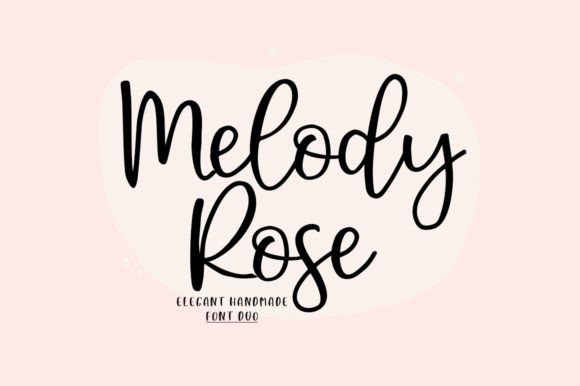
Melody Rose Duo: A Handwritten Script + Sans Serif Font for Crafters
As someone who designs printable wall art, hand-paints boutique tags, cuts vinyl stickers for small-batch candles, and creates wedding invitation suites for local clients, I’ve learned that font choice isn’t just about aesthetics—it’s about clarity, consistency, and quiet confidence in your brand. That’s why Melody Rose Duo has become my go-to pair for projects where charm meets commercial practicality.
Melody Rose Duo is a thoughtfully crafted font duo: one expressive, friendly handwritten script—and one clean, warm sans serif—designed to work beautifully together. Neither feels stiff nor overly decorative. The script has gentle curves, subtle bounce, and consistent spacing—no awkward overlaps or fragile terminals that vanish when cut at ¼ inch on a Cricut. The sans serif complements it perfectly: rounded but grounded, legible at 8 pt on a product label, yet soft enough to feel handmade rather than corporate.
I use the script for names, titles, and short emotional phrases—“Hand-Poured,” “Made with Love,” “Welcome Home”—and the sans for ingredients, dates, sizes, and fine print. This pairing solves a real problem: how to keep packaging, signage, and digital downloads feeling personal *and* professional. A candle label using only script can look precious but hard to read; using only sans can feel sterile. Melody Rose Duo bridges that gap without needing extra design layers or font substitutions.
For physical products, readability is non-negotiable. I tested Melody Rose Duo across several uses: laser-printed tea box labels (24 pt), heat-transfer vinyl on cotton tote bags (36 pt), and die-cut sticker sheets for planner stickers (10–12 pt). In every case, the script held its shape—no broken connections, no thin strokes collapsing during cutting. The sans serif stayed crisp even at 6 pt on hang tags for handmade soaps. That reliability saves time in mockup revisions and reprints.
Seasonal and themed projects benefit especially from this duo. For spring farmer’s market booths, I pair the script (“Fresh Eggs • Every Tuesday”) with the sans (“Farmhouse Fresh • Est. 2019”) on chalkboard-style signs. For holiday gift tags, the script adds warmth to “To: Emma” while the sans handles “From: Aunt Lisa • Dec 2024” cleanly. Wedding welcome boards? Script for “Welcome to Our Day,” sans for the ceremony time and location. It’s versatile—but never generic.
What makes Melody Rose Duo stand out in the Script Amp category is its attention to craft-scale detail. It includes standard ligatures (like “fi” and “fl”), contextual alternates that soften repeated letters (so “Merry Christmas” doesn’t look like a string of identical “r”s), and a full set of uppercase swashes—just enough flair for invitations or SVG-based greeting cards, without overwhelming smaller applications. All files are delivered in OTF and TTF formats, compatible with Silhouette Studio, Cricut Design Space, Canva, Adobe Illustrator, and Procreate.
Font pairing is intuitive here—you don’t need to overthink it. Because the duo already balances personality and function, you rarely need a third font. But when you do (say, for a layered SVG quote poster), I’ll occasionally add a light serif for body text—something like Playfair Display Light—to contrast the warmth of the sans without competing with the script’s voice. The key is keeping hierarchy clear: script for emotion, sans for information, serif (if used) for context.
Real-world examples I’ve shipped recently:
- Candle labels: Script for scent name (“Lavender & Linen”), sans for net weight and safety warnings
- Printable baby shower invites: Script for “You’re Invited!”, sans for date, time, RSVP details
- Farmhouse-style wooden signs: Script for “Gather Here”, sans for family name and year
- Digital planner bundles: Script headers for monthly goals, sans for checkboxes and dated sections
- Holiday mug wraps: Script for “Cozy Season”, sans for care instructions printed along the bottom edge
One thing I always double-check before listing anything for sale: licensing. Melody Rose Duo comes with an extended commercial license—meaning you can use it on physical products you sell (stickers, mugs, apparel), in digital templates and printables (Etsy PDFs, Canva kits), SVG files for craft cutting machines, and client branding projects. No hidden restrictions. That peace of mind matters when you’re scaling from hobby to small business.
It’s also worth noting that Melody Rose Duo supports basic Latin multilingual characters—so if you sell in bilingual markets or create Spanish- or French-language greeting cards, accents like é, ñ, and ü render cleanly. Not full Central/Eastern European support, but more than enough for most U.S.-based craft sellers and stationery designers.
If you’re building a cohesive brand identity—not just for one product but across labels, social posts, packaging, and web graphics—having a reliable, expressive typeface duo like Melody Rose makes consistency effortless. Customers begin to recognize your style not just by color or illustration, but by the gentle rhythm of your lettering. That subtle familiarity builds trust. And in handmade markets, trust is what turns first-time buyers into repeat customers.
Melody Rose Duo isn’t flashy. It won’t shout. But it listens—to your product, your audience, and the quiet intention behind every handmade item you make. Whether you’re designing a $3 sticker sheet or a $120 wedding suite, it gives your words presence without pretense. And in a world full of overdesigned fonts, that kind of thoughtful simplicity is rare. And useful. And honestly? A little bit lovely.